The Power of Challah

I bake and give away a lot of freshly baked bread. I’ve been baking bread weekly, sometimes daily, for many moons and my floury perspective has offered insight on what Joe Eater likes best in the bread department. And it’s challah, hands down.

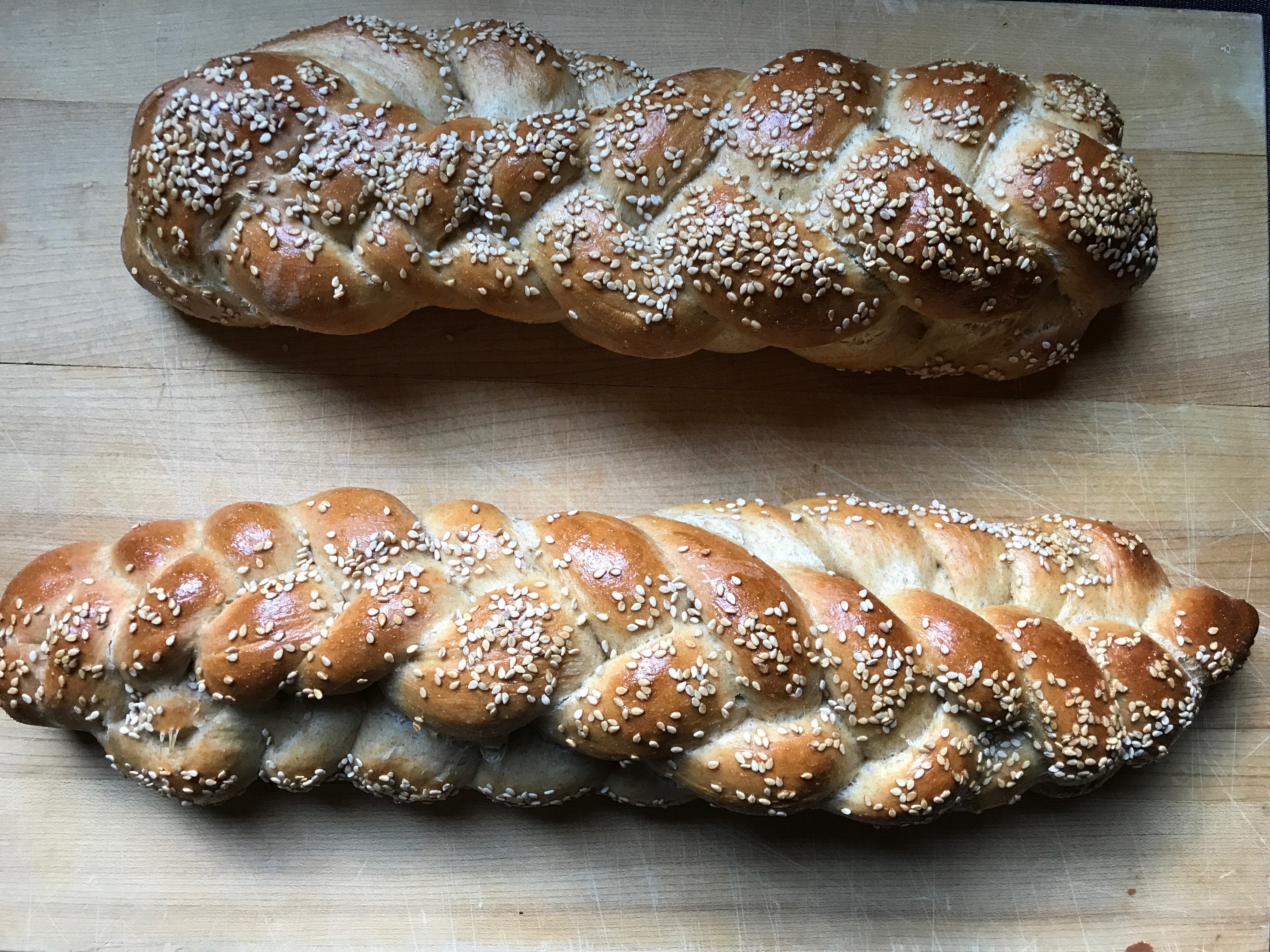
Essentially, we bread lovers eat with our eyes first. Appearances matter.  Just the sight of one of my golden, glossy braids is enough to bring most of my beneficiaries to their knees. Sprinkle on some sesame or poppy seeds (or both) and you’ve got a bagel hybrid that screams for a slathering of cream cheese,  followed by an unabashed crescendo of jam.

“What’s not to love?” my Long Island New York mother-in-law used to ask.

Ethel, of course, would only take a sliver of a slice, knowing full well that the honey, milk, butter and eggs that enrich and enliven challah were the kiss of dietary death for a diabetic like her.  But that wouldn’t stop her from kveln about my challah.

My friend Danny, on the other hand, used to scrunch and contort her mien whenever she came face to face with one of my challahs.

“No! No, you can’t do this to me!” she’d wail, tossing the gift loaf back into my hands like a hot tamale.

Turns out she was an addict.

Then there was Don. He ignited my baking passion and passed the challah gene down to our offspring.

I’d find him drooling and star struck, gazing with deep longing at my just-out-of-the-oven golden, glossy loaves.  I’d start wielding my bread knife, slashing it through the air, marking the end of each word with a vicious swipe   “Don’t you dare” Slash, slash, slash!  “devour it all!”  He’d feign to cower then leave only crumbs in his wake.    

Oh, the allure, the gloss and glimmer of a challah’s golden crust, twisting and turning seductively before our hungry eyes. Blessedly for us bakers, it is a no-brainer of a baking feat. Sure, you need to have the larder well stocked with milk, honey, eggs and butter, but you’ll find the braid an easier dough trick than your average high hydration, Tartine-style boule.

What’s more, this is a bread recipe that will make you a baking icon among friends and family. You don’t have to capture wild yeast for 10 days to make this baby rise and if you practice this just once, you’ll soon be a baking pro worthy of  Zoom coverage at the socially-distanced table.

But before you plunge into this bake, let’s talk flour:  Seriously good flour, that’s local, freshly ground and can be delivered to your door. 1847 Stone Milled Flour https://1847.ca  produces a variety of organic stone milled flours in Fergus, Ontario that bring this challah out of the land of white bread and into a world of healthy, rich flavour.
1847 Challah, Sponge Technique

Despite the name, this challah recipe doesn’t date back to 1847. I created it  recently to feature 1847’s Red Fife and Daily Grind, but both of these whole grain flours can be substituted with other brands.

Sponge

2 cups warm milk

4 eggs  lightly beaten

¼ cup   honey

9 oz/2 cups     1847 Red Fife

4.8 oz/ 1 cup   PC Organic All purpose, unbleached flour

1 tsp                instant yeast

Final Dough

¼ cup               melted unsalted butter

.6 oz/1 TBS      salt

10 oz               1847 Daily Grind (whole grain multi-purpose flour)

12 oz               PC Organic All purpose, unbleached flour

1                      egg, beaten

¼ cup               sesame seeds

Combine all the Sponge ingredients in the bowl of a KitchenAid mixer using the paddle attachment until just mixed. Cover and leave at room temperature for 2 hrs or until the surface is covered with small holes, just like a sponge.

Add butter, salt, Daily Grind and all-purpose flour to the sponge.  Using a dough hook, mix for 8 min or until the dough balls up around the hook. Add a tablespoon or two of flour during the last 2 min of the mix if the dough is not pulling away from the sides of the bowl.

Transfer to an oiled plastic bin with cover for a bulk ferment (or proof) of 2hrs. (Alternately, slow down the ferment and put it in the fridge overnight for 8-12 hrs)

Line two baking sheets with parchment. Place the room temperature or refrigerated dough on a lightly floured surface. Use a dough scraper to cut in half.  Cut each half into thirds. Roll out each piece to create six long ropes. Make two simple braids with three strands each and place on baking sheets. Cover with a clean dish towel or oiled plastic wrap and let rise for 1 hour or until doubled in size.

Bake in a preheated 350 F oven for 25-30 min or until internal temperature reaches 190 F 

Scape Kale Pesto

Makes 1 1/2 cups

Scapes can blow your socks off. A pure pesto of green garlic tops can reduce even the most ardent of garlic lovers into a wimp. Kale is the answer. It softens the garlic bite and adds a fresh vegetal flavour. Lemon juice brightens it up, both visually and on the palate. 

1/3 cup pine nuts, toasted

8-10 scapes, chopped into 1/2 inch pieces

2 cups baby kale or coarsely chopped kale, stems removed 

3 tbsp lemon juice

1/2 cup olive oil

3/4 cup grated parmesan 

Pinch salt

Freshly ground black pepper

Toast the pine nuts in a dry frying pan over medium high heat.  Stir constantly and take off heat once golden brown and oily. 

Drop scapes and pine nuts down the feeding tube of a food processor while running at high and process until finely chopped. Add kale and lemon juice into the bowl, scrape down the sides and pulse on high until a lime green paste is created. Pour olive oil down the feeding tube with motor on high to blend well.  Stir in cheese, salt and pepper, to taste. 

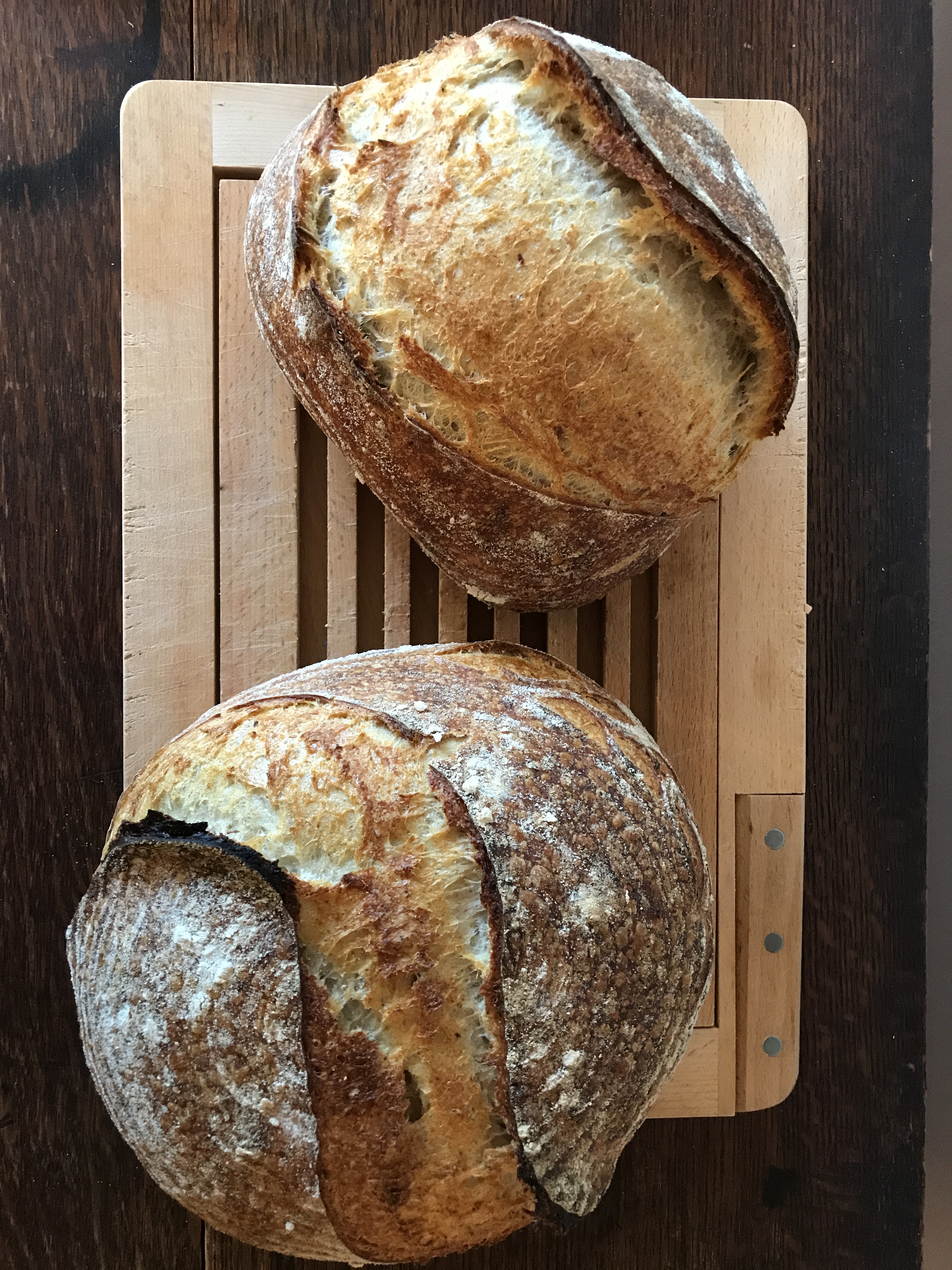
No rise blues: An ode to sourdough bakers

Many bakers send me private photos of their loaves attached with rude, judge-y remarks. 

“Pancakes.” 

“F$%#-ing catastrophe.”

“Dismal deflation.”

“Friggin’ flat tire.” 

These are just a few of the adjectives frustrated bakers announce when a loaf doesn’t bounce up to the height they had seen in their dreams or worse still, Instagram.   

I try to console with “That happens to me all the time…” but that never really helps soften a defeated sourdough baker’s fall from grace. 

Let’s face it. Not everyone has the patience or stamina for sourdough baking, especially if you have done some or all of the following:

  1. Mixed the levain late one night.
  2. Spent the following day sloshing together a long list of ingredients in a bowl, each scoop of flour, splash of water and sprinkle of salt meticulously measured by the gram or ounce.
  3. Tugged and stretched and folded every 30 minutes for an entire afternoon or morning before shaping an unbelievably sticky blob into a boule or baton.
  4. Transferred your shaped loaves into a flour-lined banneton (upside-down, no less) searched for a shower cap or plastic wrap amid a drawer packed tornado-style with measuring cups, spoons and bench scrapers, your fingers sticky with a floury adhesive plastered on everything you touched including the handle of the fridge where the loaves will retire — yet rise —  overnight until early the next morning, grumpy and tired, you remove said sourdough loaves ever so gingerly, turn their upside-down forms upright on a parchment paper-covered sheet, score each with a sharp razor blade tremulously pinched between bent, arthritic fingers, don elbow-high, warrior-thick oven mitts, reach into a 500 F degree oven without pulling another muscle, place a hot Lodge combo cooker on the range top, remove its cover,  slide a scored loaf into it, replace the lid, emit a bovine-like moan while lifting the five-ton, molten hot-lidded combo cooker, bend back down again into the hellish heat to settle one pan and remove the next until both loaves are now blessedly in their baking place, covered until the timer dings in 20 minutes to uncover what could be the most blissful or depressing sight you’ve seen in the past 48 hours of your baking life. 

Who cares if you’ve created a splattered 2-inch pool of dough, and not the eight-inch-high bursting boule of your dreams? 

You do, if you have read this far.  Several decades of baking have taught me several lessons or simple rules. 

Rule one for success. To be a sourdough baker you must be obsessed if not on the verge of masochistic.     

Rule two. When the lid comes off and the dough has spread like a pool of blood, tell your ego to shut-up and wonder why. (If George hadn’t been curious, he wouldn’t have lived through all those books).  Was my starter fresh, strong and resilient enough?  Did I shape the boule to have sufficient tension? Am I scoring art or slashing their hearts? Is my flour organic, local and freshly milled? Am I using chlorinated water or sweet spring H2O?

Rule three. Know your dough like the back of your hand, the nose on your face, your third eye, whatever.  When you fail, try the very same bread recipe again, yes, again, without complaining or holding your breath. Just observe.  Do that three-day process all over again making it a meditation on sticky versus wet, pliable versus loose. Wonder how far you can gently stretch the dough without tearing. Do you want to maintain those bubbles or press them out? What is the ambient temperature of your kitchen? Have you tried putting a thermometer in your flour, dough or water? 

Last rule: Post every winner on Instagram and quietly embrace your losers. Listen to your palate because sourdough ugly ducklings offer up rich, artisanal flavours you’ll never taste in store-bought.

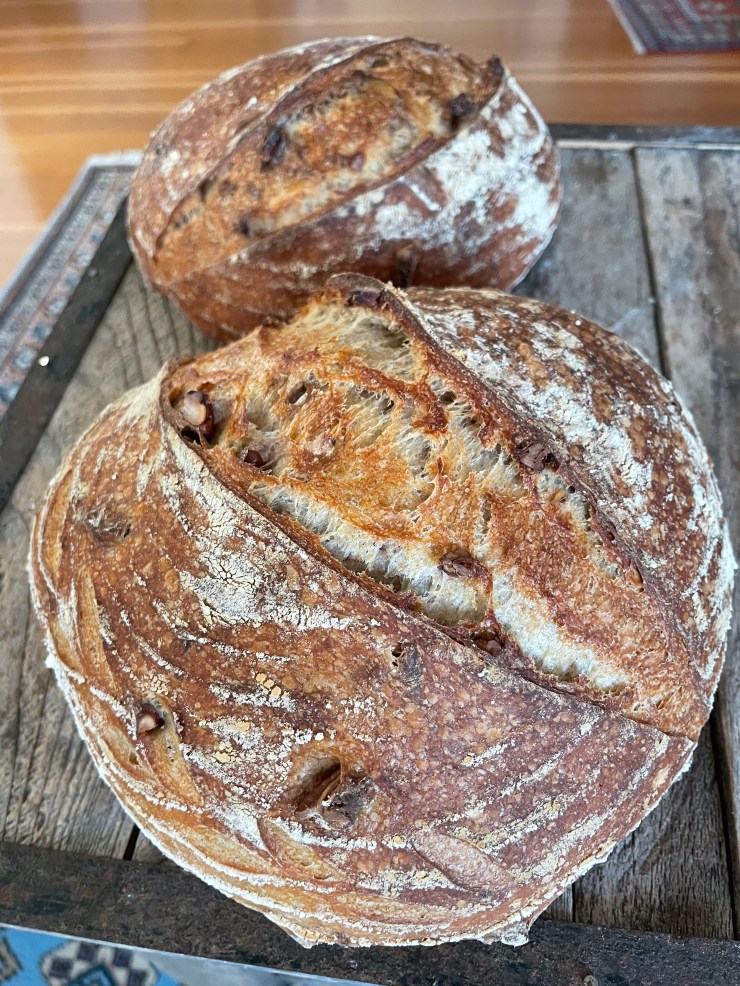
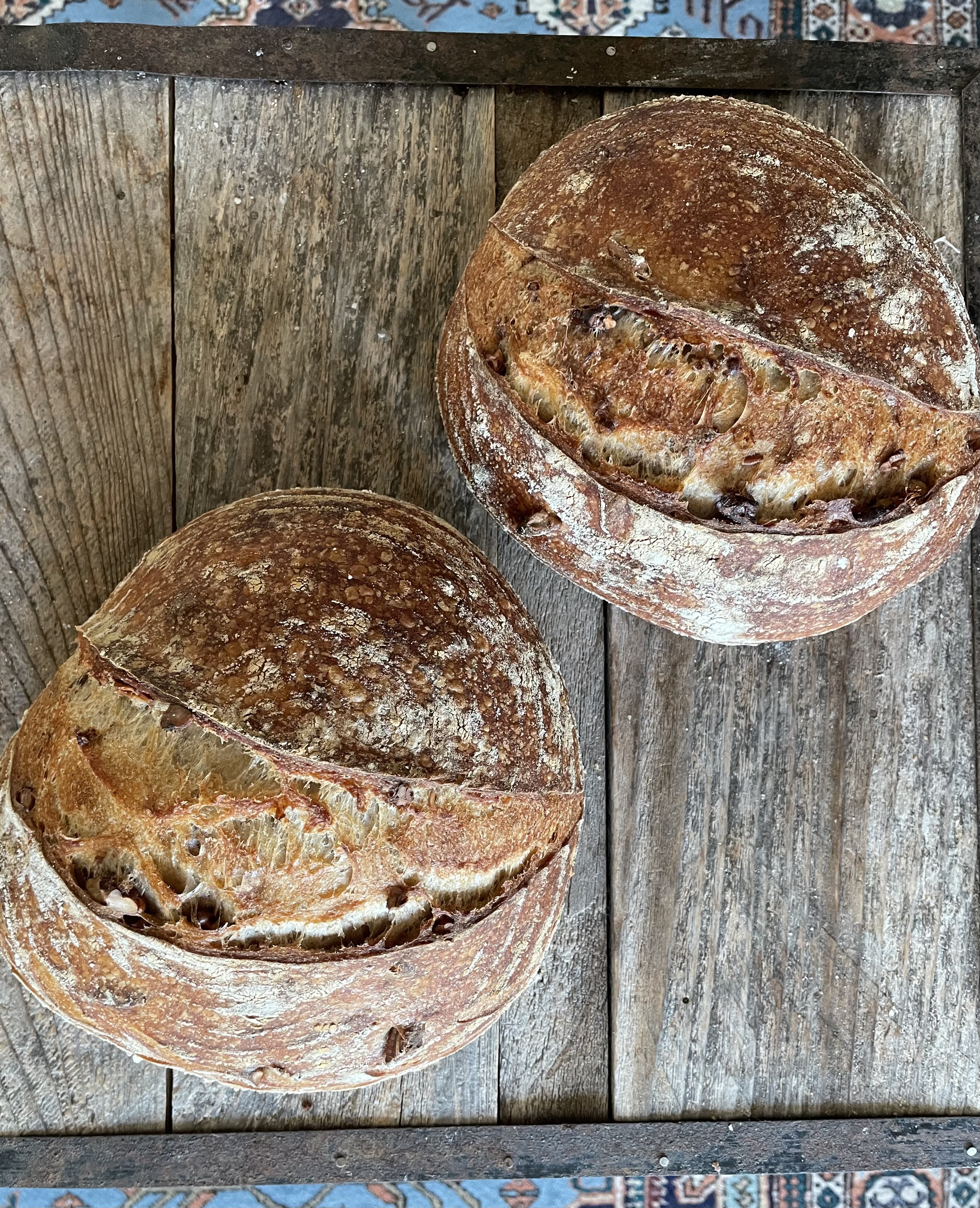
Apple Pecan Sourdough

Makes 2 loaves

This bread is adapted from Sarah Owen’s brilliant Butternut Squash and Cherry Bread found in Sourdough. Freshly ground flour ramps up the taste factor 100 per cent. 

Stiff levain

30 g 100% hydration starter

60 g  water

85 g  organic, unbleached hard white bread flour

Final dough

175 g stiff levain

250 g thick, preferably homemade apple sauce

355 g water

45 g honey

525 g organic, unbleached hard white bread flour

140 g whole spelt flour

30 g whole rye flour

14 g sea salt (Guérande, a gray, coarse salt from Brittany is my favourite for bread)  

1 cup toasted pecan pieces

Make the levain in a medium bowl, mix with your hand and knead into a small ball. Cover with plastic wrap and leave to ferment at room temperature for 8 to 10 hours or when it is tightly domed. (You can refrigerate after 7 hrs and keep there for up to 6 hrs if your schedule requires).

In a large bin or bowl, combine stiff levain, apple sauce, water and honey. Using your hand, break up and squeeze the levain until it breaks down into a bubbly, cloudy mix.  Add flour, spelt and flour, mixing with your hands,  a Danish dough whisk or large spoon. Cover and leave to autolyze for about 20 minutes. Sprinkle over with salt and mix it into the dough, squeezing and grabbing the dough, with a moist hand until a dough forms with no dry flour bits. Cover and bulk ferment for 2 hours, turning and folding every 30-40 minutes.  Fold in toasted pecans and continue to ferment another 1-2 hours, or until the dough is puffy and almost doubled in size, knowing that hot summer temperatures raise dough faster. 

Sprinkle brown rice flour inside lined bowls or bannetons to prevent sticking. On a lightly floured surface, halve the dough into two pieces, shape and place seam-side up, covering with shower caps or closed plastic bags. Refrigerate 8-12 hours. 

Preheat two Lodge combo cooker pans in the bottom rack of a 500 F oven. Depending on your oven this will take 30-60 min.

Remove raised loaves from the refrigerator, uncover and place a piece of parchment paper and small cutting board over each one. Flip each one over to release the dough and score. Wearing heavy duty oven gloves, remove one heated combo cooker. Remove the cover. Slide the scored loaf into the shallow bottom pan, replace cover and return to the oven. Repeat. Reduce the oven to 450 F and set timer for 20 minutes.  Carefully remove covers and leave to bake another 15-25 min, until loaves are golden brown. Cool on baking rack for an hour before serving.  

Tip

Making your own applesauce is easy to do. Core and quarter 4 large organic apples, place in a medium saucepan, add 1/2 cup water, cover and heat on medium.  Cook, stirring occasionally for about 5 minutes or until the apples are soft enough to mash into a puree. 

Tip

Toasting nuts and seeds brings out rich flavour but it’s easy to burn them, instead. Try toasting in a dry frying pan over medium-high heat, stirring and watching until golden brown. It helps to have raw ones nearby to compare colouring. If smoke appears, take off heat immediately.


Banana Pecan Flax Bread

Banana Pecan Flax Bread

These dark brown loaves are sweet, airy and bursting with whole grains. I always have a bag of really ripe bananas in my freezer ready to do their job. I freeze bananas in their skins and defrost on the counter in a big bowl after rinsing with tepid water. Don’t worry about all the water expelled and mash until well combined. If you aren’t using frozen bananas, reduce the cooking time by 5 or 10 min. Sourdough discard improves the crumb of this quick bread, but is optional. 

Preheat oven 350 F

1 ½ cups organic all-purpose white

1 ½ cups whole spelt, emmer, spring wheat or red fife 

½ cup ground flax seed

1 tbsp baking powder 

1 tsp baking soda

1 tsp salt

1/2 tsp cinnamon 

2/3 cup organic sunflower, canola oil or melted unsalted butter 

1 ¼ cup brown sugar

4 eggs

6-8 ripe bananas 

½ cup plain yogurt

1/2 -1 cup refrigerated sourdough discard (up to 1 month old) * optional

1 cup toasted pecans or walnuts

In a large bowl, whisk together all purpose, spelt, ground flax seed, baking powder, baking soda, salt and cinnamon.   

Cream oil or butter with brown sugar in an electric mixing bowl using the whisk attachment. Add eggs, one by one. Mix in mashed bananas, yogurt and sourdough discard, if using.  

Add dry ingredients to wet and mix/fold gently until combined.  

Pour into two greased bread loaf pans.   

Bake 60-70 minutes or until a tester comes out clean from the centre of the loaf.  Allow to rest in the pans for 5 minutes. Carefully turn out on to baking racks and leave to cool.

Soup, A Way of Life

Years ago I bought a big, thick cookbook titled “Soup” with a perplexing subheading: “A way of life”. 

I’ve pondered the logic of that title forever. How could a bowlful of tomato, bean or chicken noodle soup determine one’s lifestyle?  Wasn’t this the domain of style or taste?  

But it turns out soup is just that — especially at breakfast. 

When I first witnessed Taipei office workers perched on stools at early morning street stalls slurping down hot steaming bowlfuls of doujiang, while dipping crispy, deep-fried bread sticks into a hot melange of soy bean soup, I knew it wasn’t for me. I could abide by doujiang as a late night snack, especially for its fabled anti-hangover abilities, but nope, not the morning after.

Ditto, say soup naysayers, when it comes to a dinner revolving around soup. A small appetizer, perhaps, but who in their right mind would make soup the star after six? 

Hot summer temperatures also tend to drive many people as far from soup as possible.  Yet not so in the Caribbean where scalding bowlfuls of callaloo or black-eyed pea soup not only assuage hunger but -get this- reduce body heat with cooling streams of sweat.

If anyone is guilty of a soup lifestyle, it’s me. It’s my go-to meal for lunch, dinner and snacks in between.  I make it by the vat full, counting on numerous labeled leftovers to pile into the freezer, otherwise known as my kitchen’s Taste Archives.  

Next time you ponder your lifestyle, consider pouring more soup into it. 

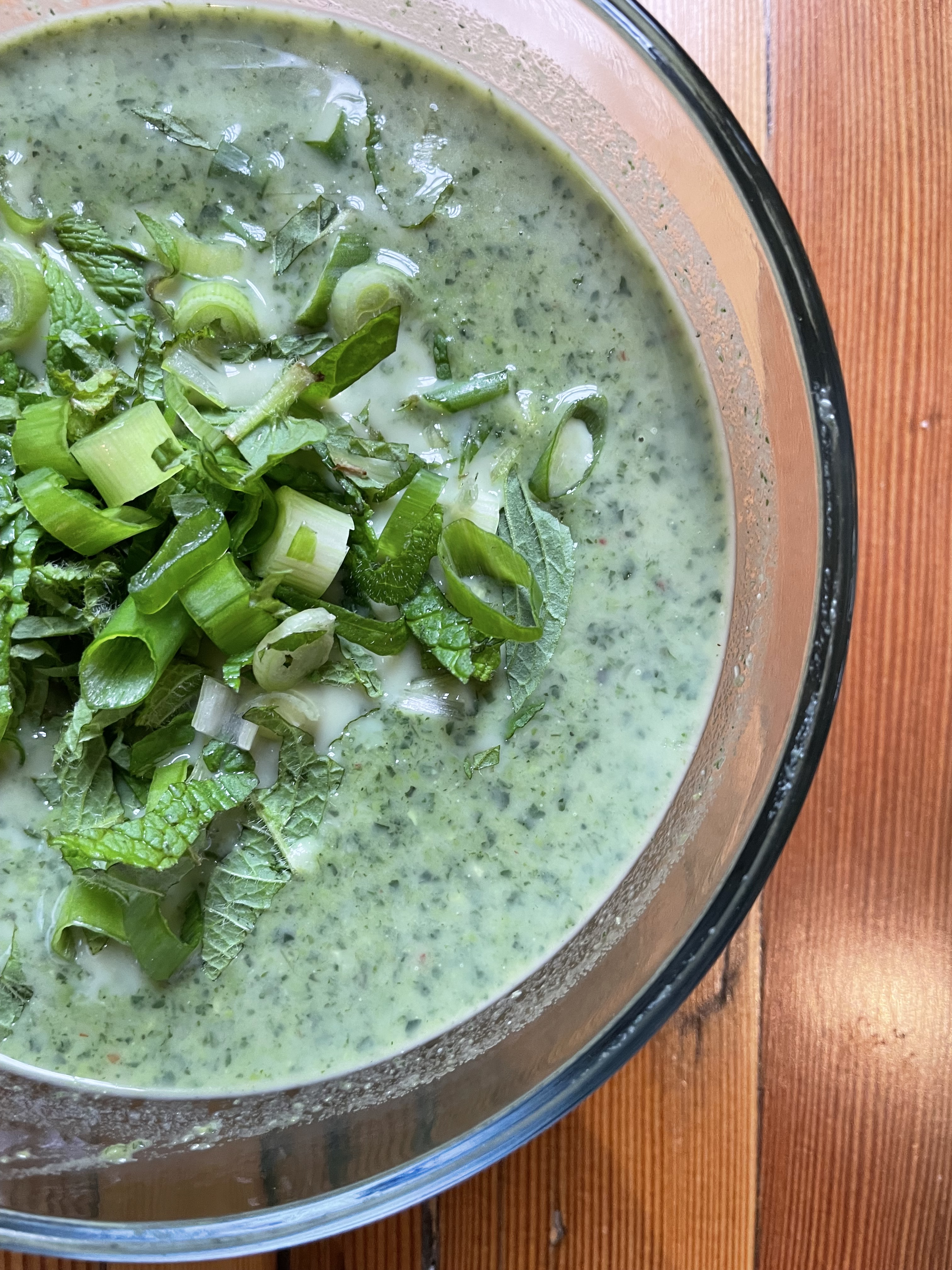
“Potage

This lush green soup  can be served hot or cold, preferably with a dollop of sour cream or cream-top yogurt and a flurry of fresh herbs.  

2 Tbsp olive oil

1 cooking onion, chopped

2 celery stalks, chopped

1 carrot, chopped

2 broccoli heads and stalks, chopped and separated

6 cups chicken or vegetable stock

1 cup frozen green peas

2 cups packed spinach leaves 

1 bay leaf

1 tsp dijon mustard

1/2 tsp cayenne

1/2 tsp freshly ground black pepper

1 tsp salt  

2 tbsp white wine or white balsamic vinegar

1/2-1 cup sour cream 

Green onions 

Fresh mint

Heat a large pot, add oil and sauté onion, celery, carrot and broccoli stalks until tender and fragrant. Add stock and bring to a boil.  Add broccoli florets, peas, spinach leaves, bay leaf, dijon mustard, cayenne, black pepper, salt and white wine or vinegar.   Simmer covered until just tender, about 5-7 minutes. Remove bay leaf. Puree with an immersion blender. Whisk in sour cream or yogurt.  Serve hot immediately or refrigerate and serve chilled. Garnish with fresh mint and green onions.


Potato Bread

Whenever I buy a big bag of potatoes, I like to bake them all as soon as I can, before they languish in a cupboard, start to sprout and end up in the compost. I choose organic because they have double the flavour and nutrition.  

I scrub them under running water, but I don’t peel them. I prick each with a fork and leave them to dry on a clean tea towel as the oven heats to 425F.  Once it’s ready and hot, I open the oven and try to put each tater on the hot rack without any fall-throughs to the oven floor. I love the sizzling sputter when the cold potato skins hit the hot bars. 

It’s impossible to over-bake a potato, they just get fluffier and more intensely flavoured with time — but it is possible to have potato explosions when the taut, tight skin breaks. That’s why I prick them, to release the hot air. Yet, if you leave a little guy in there too along alongside bigger potatoes that are still under-done, you may hear a commotion behind the oven door and find sticky potato confetti splattered throughout. 

The best time to eat a baked potato is when it is hot out of the oven with a melting nob of butter and a sprinkle of Vancouver Island salt. 

The second best time is to bake it, again, in bread. 

Potatoes and bread are partners in starch crime. A potato makes bread fluffier and the crumb richer. If you prefer to boil your potatoes, save the (cooled) cooking water, for that also makes a flavour-filled difference when added to levain, sourdough or yeasted dough. 

The recipe below is loaded with garlic, too.  Roasting garlic takes away the harsh bite of fresh and turns it into a sticky, spreadable goo.  Equally sticky is this bread’s stiff levain. Running a plastic bowl scraper under water may help to remove it from the bowl in a large piece which you can break into chunks using wet hands. 

Freshly baked bread, whether it contains potatoes or not, will make your friends and family delirious with joy and is worth every sticky messy gooey part of the cleanup.  

Roasted Potato, Garlic and Spelt Levain

Adding potatoes to bread dough creates a fluffy, richly flavoured crumb, especially with the addition of roasted garlic. Yukon gold or yellow-fleshed potatoes are perfect for the job, but fingerlings are just as tasty, too. 

2 medium potatoes (9 ounces) organic yellow-fleshed or Yukon gold potatoes  

1 head organic garlic

Sea salt

Fresh rosemary or thyme

1 tbsp olive oil

Preheat oven 425 F.  Slice 1/2 inch off  the top of the garlic head, place upright on a square of aluminum foil, sprinkle with sea salt, dried or fresh rosemary or thyme and a teaspoon of olive oil, pull four corners of foil to top and close. Place in the oven.  Prick potatoes with fork and place directly on the oven rack. Bake 45 min or until potatoes are tender and ready to explode.    

1.5 oz 100% hydration starter

6.2 oz spring water

9.6 oz white flour

In a medium glass bowl, knead starter, water and flour to create a stiff levain. Cover and leave on counter to rise and create a dome,  7-8 hrs.  I usually do this in the evening before bed.

11 oz organic whole spelt 

11 oz organic white all-purpose or bread flour 

13 oz spring water

9 oz roasted organic potatoes with skins on, crumbled 

All the gooey garlic squeezed out of the roasted head of garlic

.6 oz sea salt

Next morning, mix spelt, white flour, water, potatoes, garlic and sea salt in mixer with paddle to combine. Remove 1.5 ounce of the levain and reserve, labelled and dated in fridge. Spoon out remaining levain in chunks and add to shaggy dough.  Mix with dough hook for 3 min at first speed, increase to second speed and mix another 3 minutes, until dough is balling around the hook. Cover the bowl with plastic or a dinner plate and leave on counter for 45 min. Run your hand under water and start tugging the dough gently stretching it as far as you can without tearing then folding down on top. Repeat three more times, turning the bowl in quarters clockwise. Rest another 45 min. 

Shape the dough and place upside down or crease side up in rice flour-dusted bannetons. Cover with shower caps. Refrigerate 18-24 hours.

To bake, preheat two dutch ovens (I use LodgePan Combo Cookers) in a 500 oven for 30-60 min depending on your oven. You want the pans to get dangerously hot and you must wear long and durable oven gloves when moving the pans in and out of the oven. 

Remove fermented loaves from the fridge, take off shower caps and cut a piece of parchment paper to fit over each one.  Place a rimless baking sheet over the parchment and holding both baking sheet and banneton, flip it over, lift off banneton and score the dough as desired.  

Carefully remove one dutch oven from the oven, slide the scored dough into the base, cover and return to oven.  Repeat. Bake 20 min. Carefully remove the dutch oven lids, reduce to 450 F and bake 15-20 more minutes or until deep golden brown.

Allow to cool on baking rack for at least 30 minutes before serving.


Rhubarb: Fast & Fresh

Rhubarb. I really didn’t know if I should pick it. Nothing else in my April garden looked as ready.   

Yet there she was, boasting her verdancy amid a swirling carpet of troublesome buttercup and clumps of new grass. Rhubarb shouted out with big fat leaves the size of platters.  

She had erupted from the cold wet March soil as blood red crowns, quickly morphing into crinkly, neon-green bundles. I stopped trolling rhubarb for a couple of weeks and was shocked to find her wings unfurled.  Her massive (and toxic) wavy green leaves were hiding edible stalks beneath. 

She identifies as a fruit but is a vegetable, our lady rhubarb. 

I took a deep breath and harvested five stalks today, yanking each one from the base, a thin white filament sliced from the root ball clinging to the bottom of every stalk. 

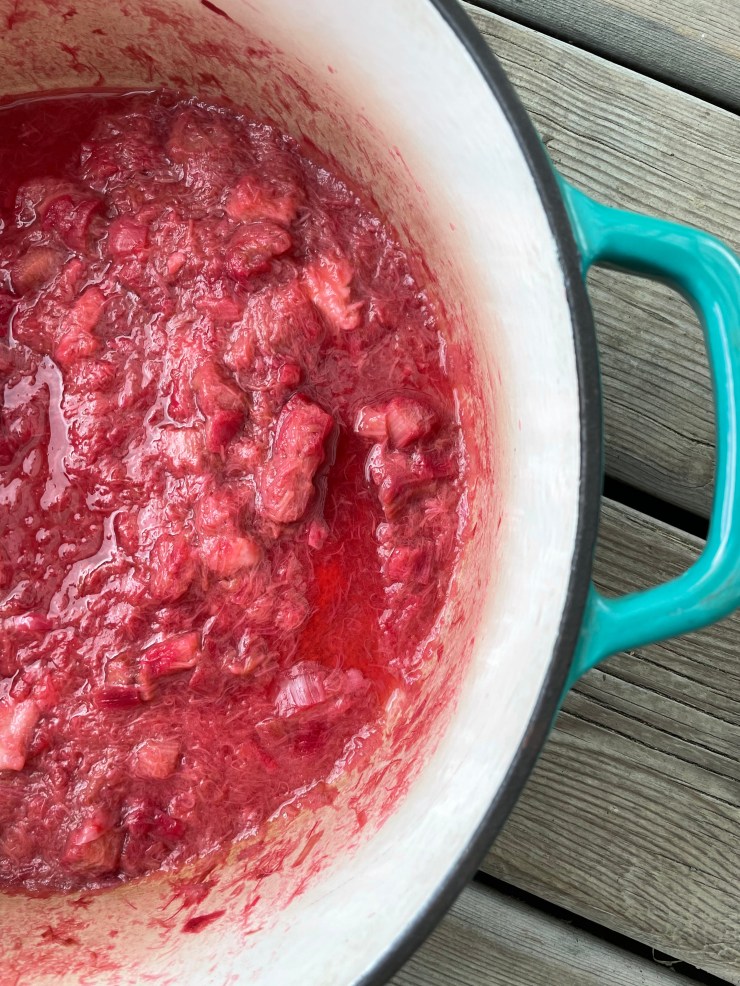
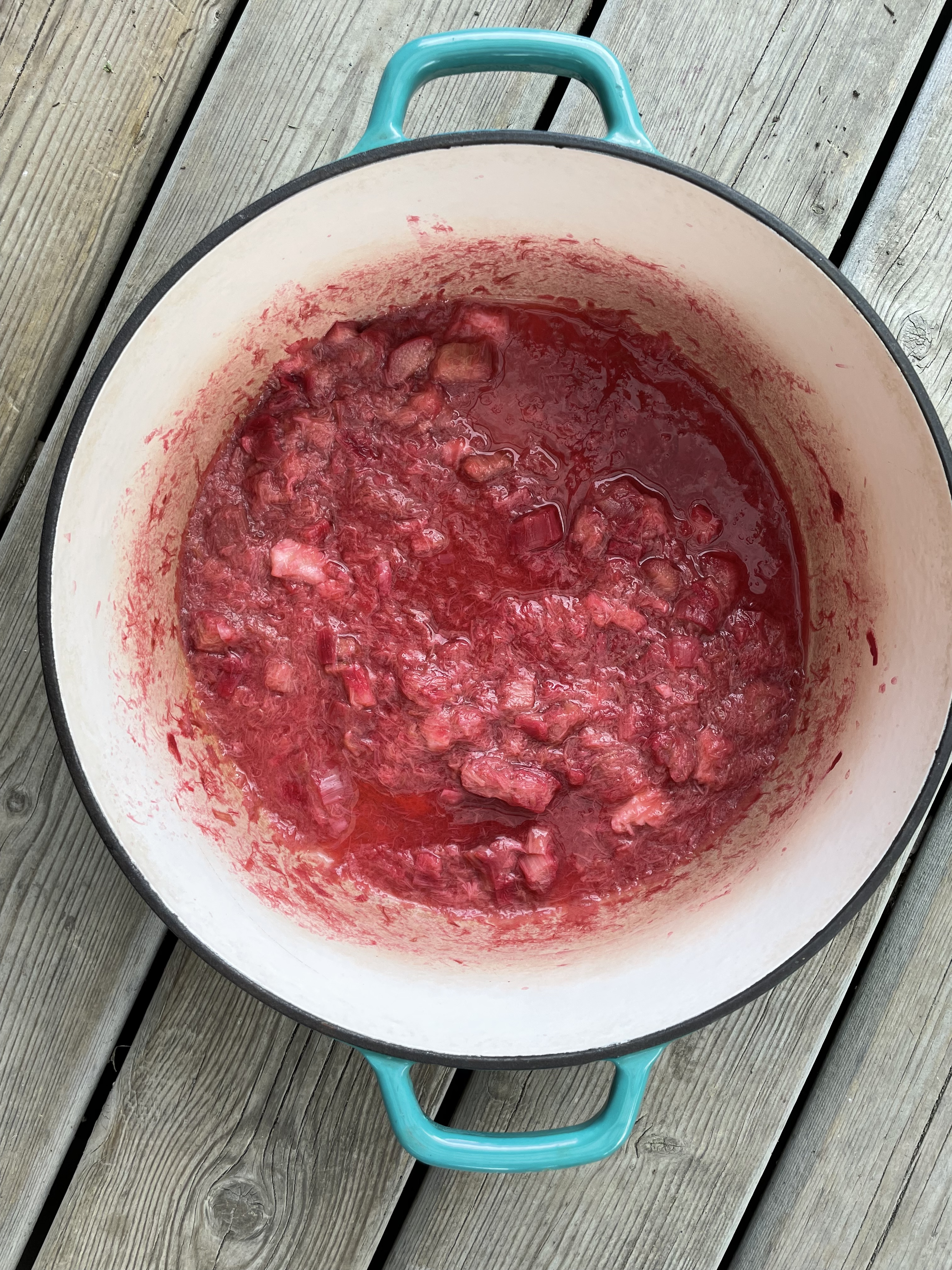
In the kitchen, I washed and trimmed my April bounty, covering the base of a wide pot with a half-inch dice. Splash went sweet apple juice over the red chunks, just to cover.  I took a large spoon and scooped out an ample portion of fine, local honey from our friend and arborist Gordon MacKay. 

Covered, the rhubarb gently simmered for no more than 10 minutes dissolving into a tangy compote ready for breakfast yogurt, dessert-time ice cream or simply solo and divine.